
IN THIS article Helen sets out some of the key differences between Bowen therapy and massage, in response to clients who sometimes ask questions.
The primary aim of remedial massage is to assess and treat musculoskeletal dysfunction to ease tension, support recovery from injury and improve mobility.
The Bowen Technique, developed in Australia and now a recognised form of bodywork around the world, does the same thing albeit in a different way, offering a holistic approach designed to address the body’s deeper regulatory systems for longer-lasting relief.
A gentle, highly effective therapy, Bowen is kinder both on the client and the therapist which represents an opportunity for massage therapists to extend their career if massage is proving physically too demanding.
Massage typically involves direct, sustained pressure focusing on specific muscle groups or problem areas. Treatment involves continuous contact, and oil is commonly applied to the skin to create ‘slip’.
In contrast, Bowen therapy is suitable for newborns right through to frail elderly and does not rely on deep pressure or oil. It is based instead on a ‘whole body’ approach working with the nervous system and fascial network at a much deeper level. The aim is to re-balance the body and enable it to heal itself by addressing the nervous system to encourage relaxation and recovery.
Bowen Technique therapist and instructor Helen trained in Swedish Massage in the Seventies and is able to compare the two modalities: “I was carrying out six full body massages every day which was very tiring, physically demanding especially on my arms and hands, while not always getting the desired results. After learning the Bowen Technique in Australia in the Nineties, I persuaded my clients to try it. The results were impressive; they recovered more quickly, recommended their friends and I was able to give up massage.
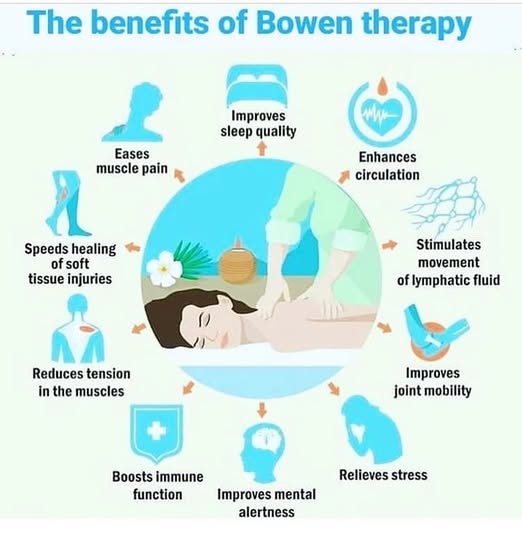
“Bowen is much kinder on the therapist as well as the client, having the potential to resolve chronic long-term conditions, not only musculoskeletal problems but also in terms of mental and emotional health,” she added.
Rather than using sustained pressure or deep manipulation, which over time can cause physical problems for the massage therapist, Bowen involves a series of precise ‘moves’ over muscles, tendons and connective tissue uniquely interspersed with short pauses.
These ‘pauses’ are the fundamental difference between Bowen and any other hands-on modality such as massage. They are essential to the effectiveness of Bowen and the body’s innate ability to reach a state of balance and healing. Each pause allows the brain to process the subtle changes initiated by the therapist, allowing time for the body to interpret this input, recognise any imbalance and kick-start a corrective response.
In addition, rather than focusing on the site of discomfort, which might in fact be caused by a problem elsewhere in the body, Bowen’s whole-body approach considers postural imbalance and nervous system responses for longer lasting improvement.
“Bowen therapy offers incredible benefits, to client and therapist. It is not a question of one being better than the other, they simply offer different experiences and outcomes,” added Helen, who is now taking bookings for beginners’ Bowen training courses starting in Peterborough and London starting in February.
More information can be found here or go to Bowen Training UK. To find a therapist near you, check out the Bowen Association UK website.